Allgrønn · A Pilot for Human Scale
The Hundred‑Metre Village
A compact, living village — an answer to what Norwegian architecture has forgotten.
Everything resembles — nothing is alike
↓ Scroll down
Allgrønn · A Pilot for Human Scale
A compact, living village — an answer to what Norwegian architecture has forgotten.
Objectives
In 1929, architect Harald Hals warned that Oslo lacked a guiding thread. In 1987, Peter Butenschøn observed that Norway had never developed a culture for coherent city-building. Professor Christian Norberg-Schulz concluded that post-war Norway suffered from "increasing placelessness." These warnings were written down, discussed, archived — and ignored.
Danish architect Jan Gehl documented the same phenomenon from another angle. In Life Between Buildings — first published in 1971, since translated into over 30 languages — he demonstrated that the quality of urban life is not determined by the buildings themselves, but by what happens between them. Scale, street edges, sensory proximity and room for spontaneous human activity are not details. They are the very precondition. Gehl spent a career documenting what we already knew but had stopped practising.
The Hundred-Metre Village is a concrete response to this accumulated knowledge: a compact urban quarter, walkable and mixed — where clear frameworks open up for architectural variation rather than closing it off. Not utopia. Not nostalgia. A methodical structure based on what we already know works.
«The real problem is that we have allowed it to become the norm — that an entire industry, an entire planning apparatus and an entire generation of decision-makers are not creating places, but building speculation.»— From the chronicle "We know what makes great places", 2026
Film and animation
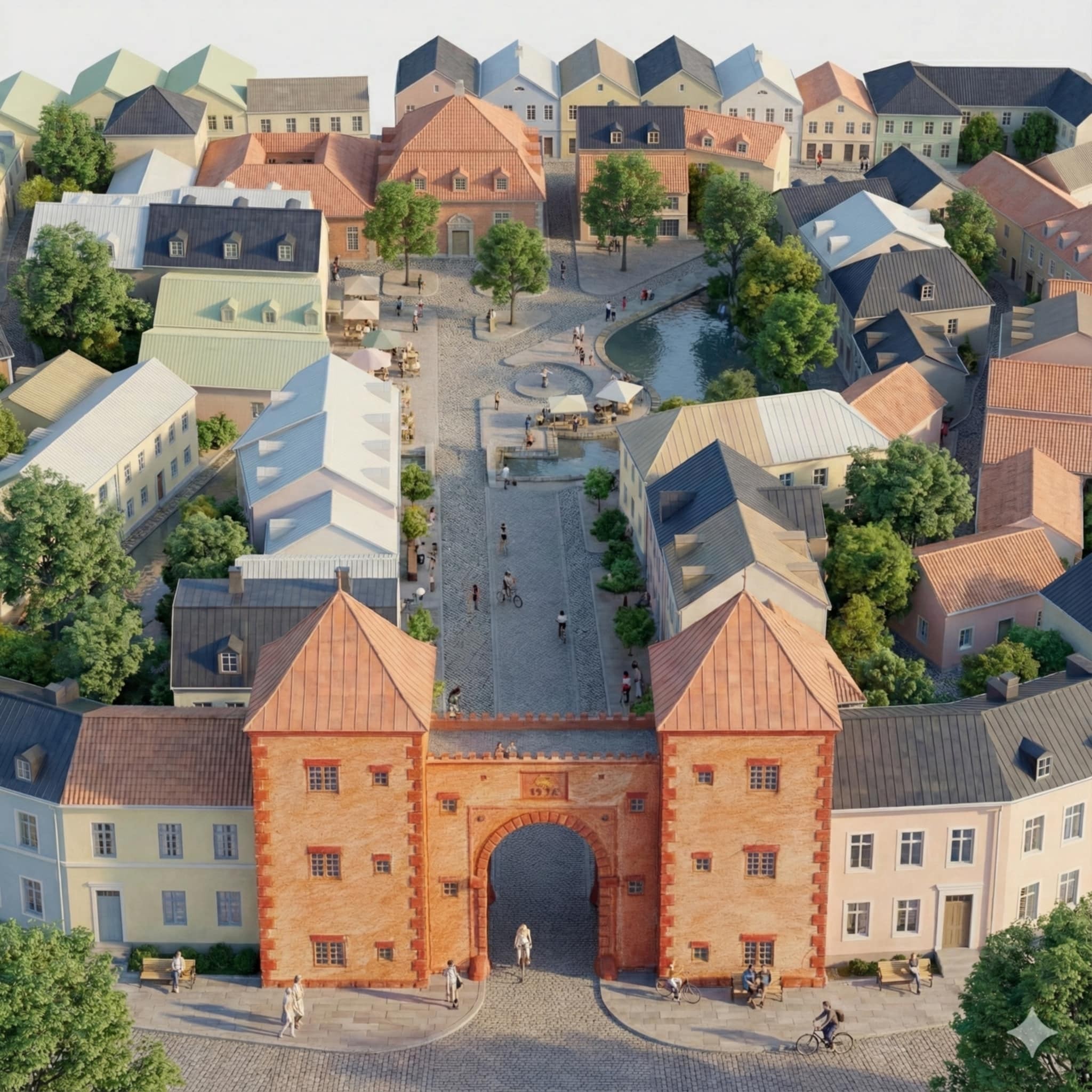
The animation above shows the Hundred-Metre Village as envisioned — with gateway, street corridor, square and varied building volumes that create room for life and community. Animation: Fredrik Nygård Stokvik. Music: Paul Okkenhaug.
The NRK recording below documents the popular debate about the village concept when it was launched in the 1990s on the NRK programme Gundersen og Grønlund.
The town's compact structure means no distance is too far to walk. A harmonious environment for all age groups.
Architecture and visual concept
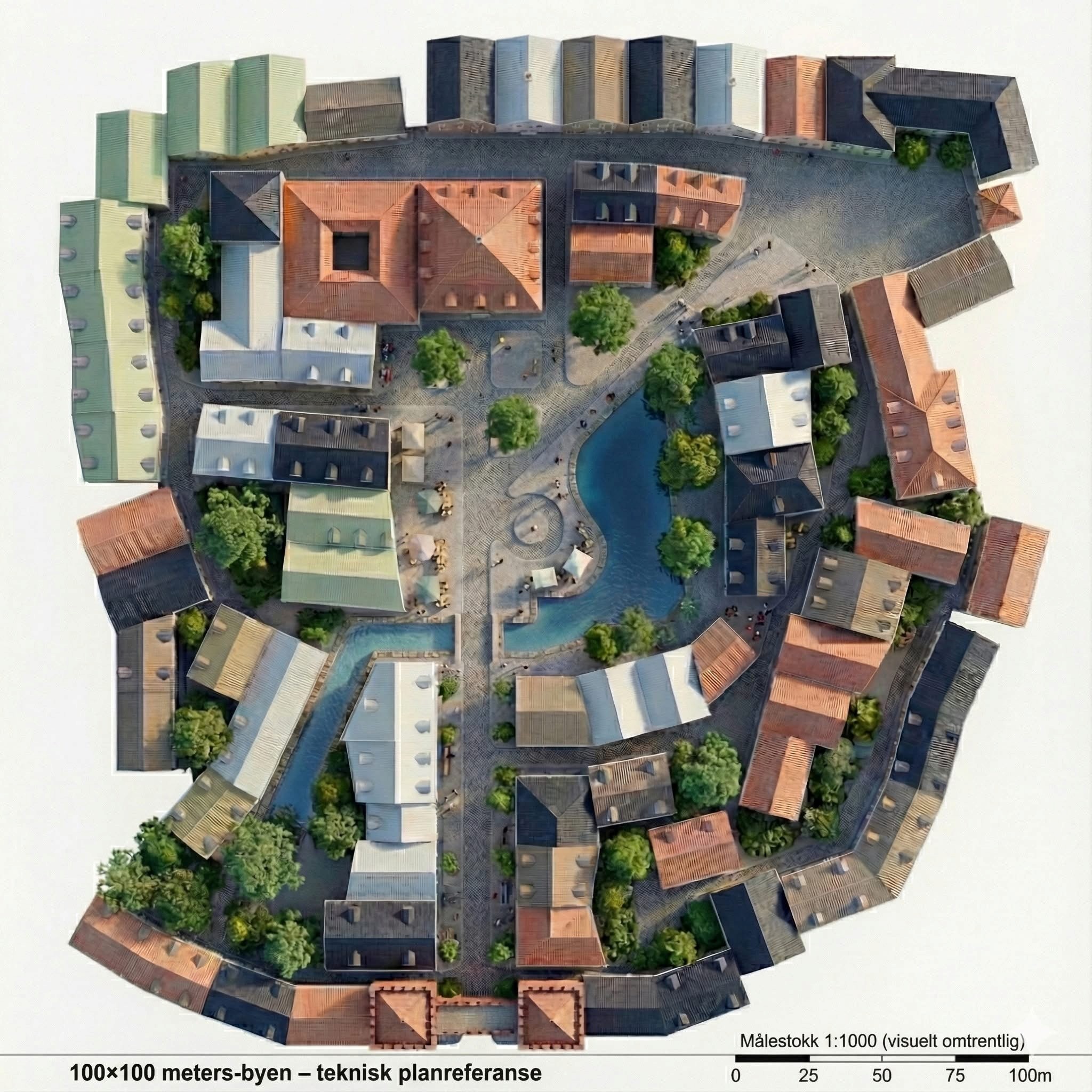
From the concept document, 1992
The settlement is clearly defined and rests as a quality within a landscape. Densification helps maintain the character of the landscape — not erase it. The Hundred-Metre Village can work as a principle in small urban quarters and on larger sites.
City walls served not only as fortifications — they also secured a place's identity. The village is encircled by an outer chain of dwellings evoking a city wall, with a natural gateway that celebrates arrival and marks the transition into the street corridor.
Human beings are irrational — and that should be allowed expression. Unpredictability, superfluity, inconvenience and excess are important contributions to mental stimulation. "Nothing is harder to imitate than randomness."
The village plans for a cross-section of age groups. The younger quarter, the elderly close to the communal hall, and natural contact surfaces between children and older residents are built into the structure.
"Everything resembles and nothing is alike" is not merely an aesthetic ambition — it is urban intelligence. Variation in facades, volumes, roof forms and materials is not decoration; it is what allows people to thrive.
The square is the multipurpose space — the heart of communal life. Every public space has water features or fountains. A river, pond or canal adds an invaluable dimension to the environment. The communal hall brings together meeting rooms, café and communal kitchen.
Building a village in a short timespan is culturally demanding. But by connecting the project to actual local materials and giving large surfaces life through patination and salvaged materials, the village can emerge as a storyteller.
In our time, the absence of cars is a rare but all the more coveted quality. Within the village, car-sharing can be embraced. No distance is too great to walk.
The project's journey
1992
Allgrønn and industrial designer Geir Olav Kuvaas sketch a compact small town inspired by studies in Czechoslovakia. The concept document "The Village — a vision of a home" is written. The proposal is published in the press and met with sharp criticism from the president of the Norwegian Association of Architects, Ole Wiig: "Amateurish. Like building an amusement park for adults."
1992–93
A series of articles for and against the village concept marks the cultural debate. Supporters point out that architects fail to understand the value of the concrete experiential knowledge that ordinary people have about what works socially and aesthetically.
1990s
The project features in NRK programmes about new urban development and human scale. Popular engagement is documented through the broadcasts.
2010s
The popular Architecture Uprising (Arkitekturopprøret) calls for traditional, human-scale architecture. Allgrønn's ideas from the early 1990s suddenly appear relevant once more. Erling Okkenhaug is active in the debate as editor and advocate.
2020s
The concept is concretised as "Hundremeterbyen" — a town that can serve as a real pilot for human scale. Various target groups are invited to participate through an "audition." The planning reference is to be developed with gateway, square, communal hall and varied quarters. Animations and technical plans are produced.
Press coverage and debate
Aftenposten · 29 May 1992
"In Norway there has been the curious notion that isolation and distance from neighbours is a condition for wellbeing. Dignified withdrawal has been seen as something positive." — Erling Okkenhaug
Aftenposten · 16 June 1992
"This is amateurish. It's like building an amusement park or Kardemomme City for adults." The head of the architects' association attacked Allgrønn's plans. The debate exploded.
Aftenposten · 18 June 1992
"If it is the case that it is groups other than architects who are working for village development in Norway, that says most about the architects." — Tore Berge, Aksjon Nærmiljø og Trafikk
Aftenposten · 29 July 1992
"Ordinary Oslo residents support Allgrønn's wish for more attractive architecture on a human scale, following a 'sustainable' urban planning idea." — Svein Solhjell
Ny Tid · 22 May 1992
"The word cosiness is unknown to architects," says Allgrønn spokesman Erling Okkenhaug, "and I am dismayed by most of what has been built in Oslo since the war."
Aftenposten · 18 January 1993
"The urban planning group Allgrønn will break decisively with the development form used for today's Norwegian towns and housing estates." New plans for a village at Vøyenenga are presented.
On architecture and human scale
«Risør, Levanger, Røros — Norwegian small towns that most people will call beautiful and human-friendly — do not exist because someone happened to make the right choices. They exist because they were built according to principles of human scale, variation within coherence, and a social logic based on proximity.»
These principles are not mysterious. They are documented, described and repeatable. The Hundred-Metre Village takes them and asks: What happens if we apply them as the basis for new development? Not as a style, not as nostalgia — but as a methodical structure.
International experience — from Poundbury in Britain to Tübingen in Germany to Houten in the Netherlands — shows that dense, small-scale development can be just as profitable as mass production. Over time, actually more profitable, because places people want to live in hold their value better.
Chronicle · 2026
«Unease without strategy changes nothing. It is not the generic facades or the car-oriented housing estates that are the problem in themselves. They are symptoms. The real problem is that we have allowed it to become the norm.»
NRK's series Stygt ("Ugly") put words to something many had long felt but could not name: We are building a country that does not resemble us. Generic apartment blocks, uniform housing estates, cities that could be anywhere in the world. The reaction was strong and broad. And then it subsided. As it always does. Because unease without strategy changes nothing.
We know enough. We have enough references. The principles of human scale, variation within coherence and social logic based on proximity are not mysterious — they are documented and repeatable. What is missing is not knowledge. It is strategy. And a pilot project that actually builds it.
Changing Norwegian building practice is a political struggle, not a professional discussion. Those not present in the room where premises are set are not part of the fight. Agenda power — the right to decide what a matter is about — is not something one claims by being right. It is something one claims by organising and persisting.
The Hundred-Metre Village and NRK's Ugly
Ugly diagnoses the problem with precision and empathy. The Hundred-Metre Village is a concrete, buildable answer. It does not argue that we should build differently — it shows how. In the same economic frameworks. With the same regulations. The diagnosis deserves a treatment.
This is not aesthetics. It is spatial ecology.
The core idea is deceptively simple: everything you need in daily life within 100 metres of your front door. Grocery, school, health service, meeting place, green space. Not as an ideal — as a planning requirement. Ugly shows what is missing. The Hundred-Metre Village shows what filling it looks like.
Ugly shows how today's development is driven by volume and economic maximisation. The Hundred-Metre Village replaces volumetric thinking with typological thinking: small buildings, varied structures, different entrances, rhythm and proportion. Instead of one large building, many small ones. Instead of one architectural idea — a place.
The places people love — old town centres, timber-house environments, European small towns — are rarely planned in a single operation. They have grown. Ugly shows what happens when this logic is broken. The Hundred-Metre Village attempts to reintroduce the organic logic in planned form: fixed frameworks, open expressions, incremental development and room for change. It produces architecture that withstands time — not just marketing.
Ugly often leaves viewers with a feeling of helplessness: "This is wrong — but what can we do?" The Hundred-Metre Village is precisely an answer to this void. It is a concrete, professional and feasible framework that municipalities, architects, developers and politicians can use. Not as an ideal, but as a tool.
The Hundred-Metre Village does not promise beautiful architecture in the advertising sense. It promises recognisability, variation, human scale, coherence and durability. These are precisely the qualities Ugly shows we are lacking.
To NRK
Ugly has done something rare: it has articulated a broad, popular discomfort with how Norway is being built. The Hundred-Metre Village gives NRK the opportunity to go one step beyond critique — to show viewers that realistic alternatives exist. Not as polished visions, but as actual rooms, streets and neighbourhoods that can be understood and compared.
The project invites architects, professional communities and students to develop different versions of the same quarter. Same plan, many expressions. Same economic framework, vastly different urban environments. This makes it possible to show, concretely and verifiably, that generic architecture is not an inevitable choice — but a choice.
This is not an idealistic side project — but an attempt to give Norway a new, feasible framework for place-making, in direct dialogue with the unease Ugly has uncovered.
Invitation to participate
We are not looking for passive stakeholders. We are looking for people and organisations who have their own reasons to want to shape the idea further — and who are willing to articulate them.
Capital and delivery capacity
Comparable projects in Europe show 10–20% higher sale prices than standard housing estate development. The compact structure delivers a finished neighbourhood feel from day one — no "half-built desert", no sales drag. The Hundred-Metre Village is a documentable business model, not an idealistic project.
We ask you: What property development have you seen that actually succeeds in creating places people will want to live in 30 years from now — and what made it possible?
Professional substance and spatial intelligence
We seek architects who understand the difference between architecture as object and architecture as context. Who can translate principles of human scale into concrete spatial structure — and who are willing to work within clear frameworks, because the frameworks are what makes variation possible.
We ask you: What is it that you as an architect cannot achieve within the constraints of normal commissions — and what would you do differently if you could shape the premises?
Agenda-setters and decision-makers
Changing Norwegian building practice is a political struggle, not merely a professional discussion. We seek politicians who understand this — and who have the courage to ask: What kind of places do we want future generations to live in? The Hundred-Metre Village can be realised in your municipality.
We ask you: What do you as a politician want to be remembered for — and is there a connection between that answer and what kind of places we leave behind?
Systemic insight and regulatory flexibility
Many obstacles to human-scale place-making are not political — they are technical. They reside in planning regulations and interpretations that have become normalised. We seek planners who know these obstacles from the inside and have the professional confidence to ask whether they are necessary.
We ask you: What does current regulation not permit that you believe should be possible — and what would it take to change that?
Building capacity and material intelligence
The Hundred-Metre Village depends on professionals who understand that variation is not a cost — it is a craft. Who know that patina, material identity and the "accidentally right" do not arise of themselves, but require conscious choices in production and execution.
We ask you: What do you as a craftsperson or contractor know about what actually makes a place good — that architects and developers don't always ask about?
Tomorrow's place-makers — not tomorrow's icon-builders
«Society's demands on architects will in the future be more about creating great places than spectacular individual buildings. The Hundred-Metre Village is a training ground for precisely that — and participation will be an important part of your CV.»
The Hundred-Metre Village is not a pre-drawn city — it is a framework. An urban quarter of 100×100 metres with a fixed structure that invites great architectural variation. We seek students at all levels who want to explore what human scale actually means in practice, not as theory, but as drawing, model and spatial thinking.
We ask you: What does your architecture education prepare you least for — and do you think the Hundred-Metre Village is a place where you can practise precisely that?
How participation works
1
Send 2–3 pages of written rationale. Not a CV, not a budget. What do you see in this project? What do you want to contribute?
2
A 1.5-day closed working seminar with 8–12 key people. The task: forge the core formulation and define what the project must never become.
3
Roles, responsibilities and contributions are clarified. The project moves from idea to implementation plan.
«If you are the one we are looking for, you already know it.»
Send your rationale to:
erling@okkenhaug.comLocal character
The Hundred-Metre Village is not one appearance. It is a structure — a way of organising proximity, mixed use and walkability. Within this structure there are as many expressions as there are Norwegian regions with their own building traditions, their own materials, their own colour palettes and their own histories of what a small town is.
The challenge is real: Norwegian place-making has for decades produced anonymous housing estates that could be anywhere. Same roof pitch, same facade material, same street lighting. The Hundred-Metre Village makes the opposite demand — that the core structure is the same, but that each place looks like exactly the place it is.
That requires a deliberate strategy for local adaptation. Not historical copying. Not picturesque scenery. But a methodical reading of what makes each place itself — and an architectural backbone robust enough to carry very different expressions.
Knowledge of materials, proportional tradition and climate adaptation are not aesthetic nostalgia. They are accumulated place wisdom — what a region has learned across generations about what holds in the local climate, what is available, what weathers beautifully and what deteriorates. The Hundred-Metre Village draws this knowledge forward and makes it operative in a modern urban planning approach.
The result should be recognisable as a Hundred-Metre Village — and impossible to mistake for any other Hundred-Metre Village.
Methodology
Every settlement carries its history in materials, proportions and spatial patterns. Map the existing building tradition systematically: roof pitch, eave height, cladding direction, window format, colour palette. These are not constraints — they are the raw material for the architecture.
The Hundred-Metre Village's backbone — block structure, building line, street and square space — is constant. The local building tradition influences the "face": facade expression, materials, details and colour choices. These two layers can be developed independently and by different actors.
In Lofoten it is whale-red and tarred boathouses. On the Southern Coast it is whitewashed timber-frame. In Gudbrandsdalen it is log construction and red-painted boarding. Climatic needs and locally available materials have always shaped building tradition — and still do.
The Hundred-Metre Village has no facade template. On the contrary: each building is erected by its owner with their architect within shared proportional frameworks. The result is the variation that characterises all living urban environments — where it is easy to see that the buildings were constructed by different people over time.
A square in Finnmark is not the same as a square on Jæren. Wind exposure, light, temperature and usage patterns vary. The square is dimensioned and oriented according to local climate knowledge. Sheltered seating in the north, open in the south. Planting adapted to the USDA zone.
What makes Risør Risør and Røros Røros is not that the buildings look alike — it is that they look as if they have lived. The Hundred-Metre Village plans for patination: materials that age beautifully, facades that change character over time, public spaces that bear traces of human activity.
Regional expressions
Write your thoughts about a region's building tradition, materials, proportions or sense of place. Your contribution is saved in a shared register that all visitors can read.
Register of local character
Loading contributions…
The Hundred-Metre Village's structure — the compact, walkable, mixed town centre — is a universal approach. But architecture is always local. Materials carry the memory of the climate. Proportions carry the tradition of the craft. Colours carry the character of the light. It is not possible to build a good Hundred-Metre Village without listening to the place it will stand on. And it is not necessary to look far for the answers — they are already there, in what was built before we stopped caring about the whole.